
How Water Spreads Through a Largo Slab Home in the First 24 Hours
Homeowners in other states picture water damage as water in the basement. In Largo there is no basement. Almost every house here sits on a concrete slab, and that single fact changes everything about how a leak behaves. Water cannot go down, so it goes sideways and up.
Understanding that path helps you make better decisions in the first day, which is when most of the outcome is decided. Below is the timeline we see on residential jobs across Pinellas County, from the first minute to the end of day one.
Minutes 0 to 30: Water Finds the Path of Least Resistance
A half-inch supply line under household pressure releases several gallons a minute. Within the first half hour, that water has covered the floor of the room it started in and pushed under the nearest doorway. Tile and vinyl plank look like barriers. They are not. Water travels along the grout line, the plank seam and the perimeter expansion gap.
It also finds the bottom plate of every wall it reaches. Drywall sits about half an inch off the slab in most construction, but the paper facing touches the floor at the base, and paper wicks water upward immediately. This is why a puddle two feet from a wall still means wet drywall.
The single most useful thing you can do in this window is close the water. In most Largo homes the main shutoff is in a meter box near the front property line and needs a meter key or a large wrench. Every fixture also has its own angle stop. If you have never located yours, do it this week rather than during a leak.
Hour 1 to Hour 3: Wicking Up the Drywall and Under the Cabinets
By the end of the first hour, drywall along the wet perimeter has drawn water an inch or two up from the floor. Baseboard, usually MDF in homes built or renovated in the last thirty years, has started swelling. Cabinet toe kicks and the particle board bottoms of sink bases and vanities are absorbing at the same time, and particle board swells faster than almost anything else in the building.
Water is also moving under the flooring assembly. On glued-down products, it works into the adhesive layer and starts breaking the bond. On floating floors, it runs freely across the moisture barrier and can travel the length of a hallway in minutes, wetting rooms that never saw a drop on the surface.
This is the window where extraction pays for itself. Pulling the free water off the floor and out of the carpet backing stops the supply feeding all that absorption. Every gallon removed now is a gallon that never has to be evaporated out of your framing later.
Hour 3 to Hour 8: Rooms You Did Not Know Were Wet
By the middle of the first day, the affected footprint is usually larger than the visible one. We routinely meter wet drywall two rooms away from a kitchen leak. Closets are the classic surprise: they share a wall with the wet room, they have no air movement, and the contents on the floor are already absorbing moisture.
Hardwood is also beginning to respond. Wood absorbs water from the bottom, swells across the grain and starts to cup, with edges rising above the centers. That process is well underway in hour six even though the floor may still look flat to the eye. This is why fast intervention decides whether a wood floor is dried or demolished, a decision covered in more detail in our walkthrough of the first steps after a supply line bursts.
Humidity in the house is climbing too. All that evaporating water has to go somewhere, and in a closed Florida house it lands on cooler surfaces: window frames, exterior wall cavities, duct boots and the inside of closets. Homeowners who open windows to help are usually raising the moisture load, because outside dew points here sit in the seventies for much of the year.
Hour 8 to Hour 24: Secondary Damage Begins
The term for what happens next is secondary damage. The original leak is over, but the moisture it released is now doing damage in places the water never physically reached. Paint blisters at the wall base. Laminate edges swell and chip. Cabinet doors swell against their frames. Tape joints in the ceiling below a second-floor leak begin to sag.
Mold is the other clock running. Given a wet organic surface, growth commonly begins within one to three days, and drywall paper facing in a warm humid house is an ideal surface. Nothing about that timeline is unusual or alarmist. It is why professional drying is measured in days rather than weeks, and why a wet cavity should never be closed up with new drywall.
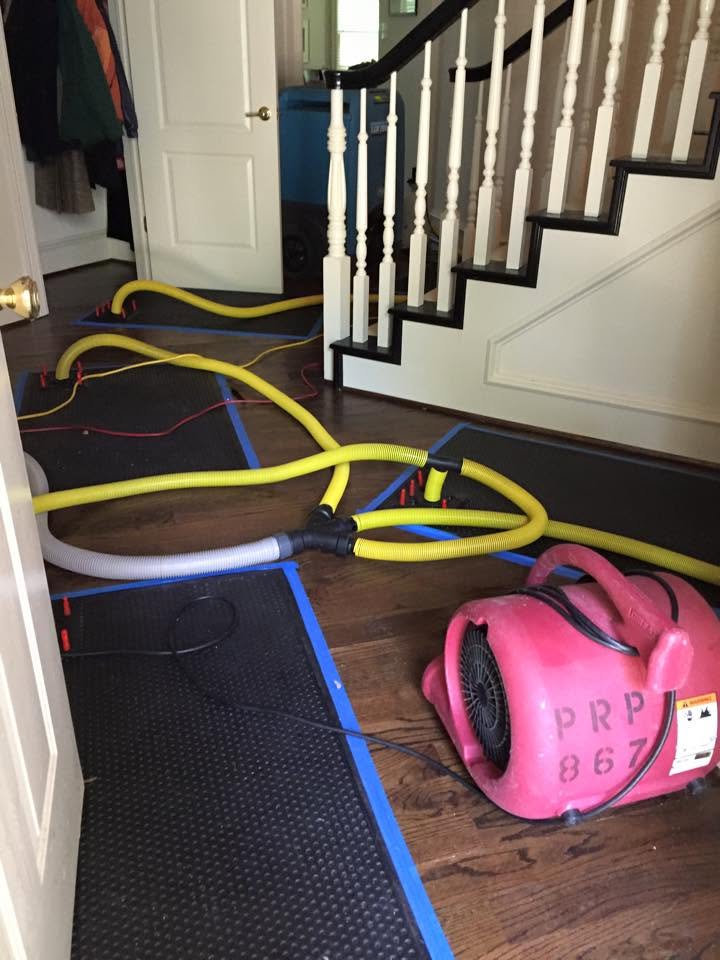
Twenty-four hours in, the practical question is no longer whether the house is wet. It is whether the moisture is being actively removed. A closed drying system with dehumidification pulls water out of the air and lets materials release what they absorbed. Fans alone move air around a house that has nowhere to put the moisture.
What This Means for Your Decisions on Day One
Three decisions matter more than the rest. First, stop the water and photograph everything before you move anything, because your insurer evaluates the original condition. Second, get the free water extracted rather than mopped, since a wet vac cannot reach under a cabinet run or into a wall base. Third, get real dehumidification into the space rather than borrowed fans.
There is also a documentation decision. Moisture readings taken on day one establish what was actually wet, which protects you later if a stain reappears or a claim is questioned. Any crew doing this work properly will be metering the drywall, the subfloor and the cabinet bases and writing those numbers down.
Why Largo Homes Behave This Way
Two local factors drive the whole timeline. The first is slab construction, which forces water horizontally into wall bases instead of downward into a basement. The second is the local moisture load. Pinellas County humidity means the air in your house cannot absorb much more water, so evaporation is slow unless a machine is pulling moisture out of that air.
Building age is the third factor. Homes from the 1950s through the 1970s have concrete block walls that hold moisture behind paint, plus cast iron drain lines and original supply piping that fail in predictable ways. Later construction brought polybutylene supply lines, which fail suddenly at the fitting. Both eras produce the losses we respond to weekly, and the mold growth timeline in Florida humidity explains why the days that follow matter as much as the first hour.
If you are dealing with an active leak right now, the priority list is short: water off, power off in wet areas, photos taken, then call for extraction and drying. Our full description of extraction, drying and repair services lays out what each step involves, and availability is confirmed when you call.
Dealing with this right now? Call and get an arrival window for your address.
Call (833) 289-9993