
What to Do First When a Supply Line Bursts in a Pinellas County Home
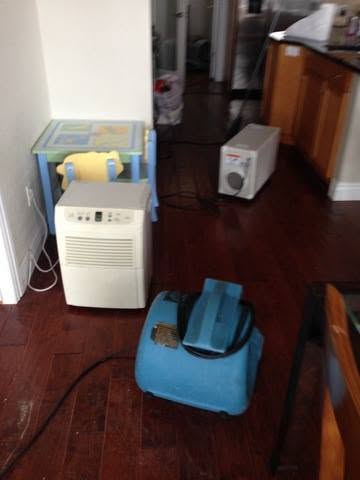
When a supply line lets go, most people spend the first ten minutes doing the least useful thing available: moving towels around. It is understandable. It is also expensive, because a pressurized line keeps delivering water the entire time. Here is the order that actually protects your house.
Step One: Close the Water, Not the Fixture
Find the shutoff that isolates the most water fastest. If the failure is at a toilet, sink or water heater, the angle stop or the tank valve right there will do it. If the line is inside a wall, in the ceiling, or you cannot tell, go to the main.
In most Pinellas County homes the main shutoff is a valve inside a meter box near the front property line, and it usually needs a meter key or a large adjustable wrench. Some homes also have a valve where the service line enters the house, often near a hose bib. Locate yours now and keep the key with it. That five-minute task is the highest-value prevention step in this entire article.
If the water will not stop, call the utility. Largo, Clearwater, Dunedin, Safety Harbor, Oldsmar and Belleair each operate their own water systems, while Palm Harbor, Seminole and many unincorporated addresses are served by Pinellas County Utilities. All of them can assist with a shutoff on the utility side.
Step Two: Cut Power to Wet Areas
Water and electricity in the same room is the one part of this that can hurt you. If water is near outlets, an electrical panel, a floor lamp, extension cords or an appliance, shut off the affected circuits at the breaker before you walk through it. If the panel itself is wet or the water is deep, do not touch it. Stay out and call an electrician or the utility.
Also look up. A ceiling holding water above a light fixture or fan is both an electrical hazard and a collapse risk. Keep people out of that room until it has been relieved in a controlled way.
Step Three: Photograph Before You Move Anything
Take wide shots of each affected room, then close-ups of the failed component, the water depth against a baseboard, and any damaged contents. Video walking through the space is even better. This takes two minutes and it is what your insurer evaluates when deciding a claim.
Do not throw anything away yet. Ruined items should be photographed and set aside until they have been documented and listed. Keep the failed part itself, especially a burst hose, a cracked fitting or a corroded valve, because it demonstrates a sudden failure rather than long-term seepage.
Step Four: Get Contents Off the Floor
Now the towels become useful, but not for the floor. Lift furniture legs onto foam blocks or foil, pick up rugs, move boxes off the slab, and get electronics, documents and anything with dye that could bleed onto flooring up and out. Wood furniture legs stain carpet and vinyl quickly, and those stains do not come out.
Prioritize by replaceability. Photographs, documents and irreplaceable items first, then electronics, then furniture. In a slab home, water spreads across the floor rather than draining away, so anything sitting on that floor is absorbing.
Step Five: Call for Extraction and Drying, Then a Plumber
These are two separate trades and the order matters. Extraction and drying protect the building, and that clock is running. A licensed plumber makes the permanent repair to the pipe, and that work is easier once the area is open and dry. On our jobs the access stays open for the plumber and the schedule is coordinated so nothing waits.
When you call, be ready with the source, how long the water ran, how far it traveled, and what type of flooring is affected. That detail determines whether we need mat systems for hardwood, cavity injection for wet walls, or large-volume extraction. Availability is confirmed when you call, and you get a specific arrival window.
Step Six: Report the Claim and Keep Your Own Record
Call your insurer promptly, within the first day if you can. Sudden accidental discharge from a plumbing system is one of the most commonly covered water losses in a homeowners policy, while long-term seepage generally is not. Reporting promptly and having photos of the failed component supports the sudden classification.
Keep your own file too: photos, the failed part, receipts for anything you bought, the mitigation company's moisture logs and the plumber's invoice. If a stain reappears next year or a buyer asks during a sale, that file answers the question.
What Not to Do
Do not open windows to dry the house. In Pinellas County the outside air usually holds more moisture than the air inside, so ventilating adds to the load. Do not rent a carpet cleaner and try to extract with it, because it lacks the vacuum to pull water out of backing and pad. Do not close up a wall or lay new flooring until moisture readings confirm the framing is dry.
And do not assume the damage stops where the water is visible. Wet drywall two rooms away is normal, and understanding how mold develops in Florida humidity over the following days is exactly why the hidden pockets have to be found and dried.
Preventing the Next One
Most of the burst line calls we take in Largo trace to a handful of components. Rubber washing machine hoses that aged from the inside. Plastic toilet supply risers and angle stops that got brittle. Water heaters past ten or twelve years with no pan or an unrouted pan line. Refrigerator ice maker lines with mineral buildup. Polybutylene supply piping installed between the late 1970s and mid 1990s, which fails at the fitting without warning.
Replacing rubber hoses with braided stainless, closing laundry valves when you travel, having a pan and drain installed at the water heater, and asking a licensed plumber whether your home still has polybutylene will prevent a large share of these losses. Our restoration and drying services page explains what happens when prevention does not get there in time.
Dealing with this right now? Call and get an arrival window for your address.
Call (833) 289-9993